

How to Optimize Your E-commerce Product Feeds for Maximum Visibility

Jiri Stepanek
Product feed optimization is the single most impactful thing you can do to improve your e-commerce performance. A well-optimized feed means better visibility in shopping channels, higher click-through rates, and ultimately more revenue. In this guide, we break down the exact strategies top-performing e-commerce teams use.
Why Optimizing E-commerce Product Feeds Is Critical in 2026
Optimizing e-commerce product feeds has evolved from a technical requirement into a strategic competitive advantage. Your product feed is the engine that powers every shopping ad, marketplace listing, and comparison engine across the digital retail landscape.
In 2026, shopping platforms use increasingly sophisticated AI algorithms to match products with buyer intent. Google Shopping's AI-powered discovery surfaces products based on semantic understanding rather than simple keyword matching. Meta's Advantage+ Shopping campaigns automatically optimize product selection based on feed quality. Amazon's A9+ algorithm prioritizes listings with complete, accurate attributes. The common thread? Feed quality directly determines visibility.
Merchants who optimize their product feeds see measurable results: 40-60% increases in impression share, 25-35% improvements in click-through rates, and 20-30% higher conversion rates compared to poorly optimized competitors. The gap between optimized and unoptimized feeds continues to widen as platforms reward data quality with better placements and lower costs.
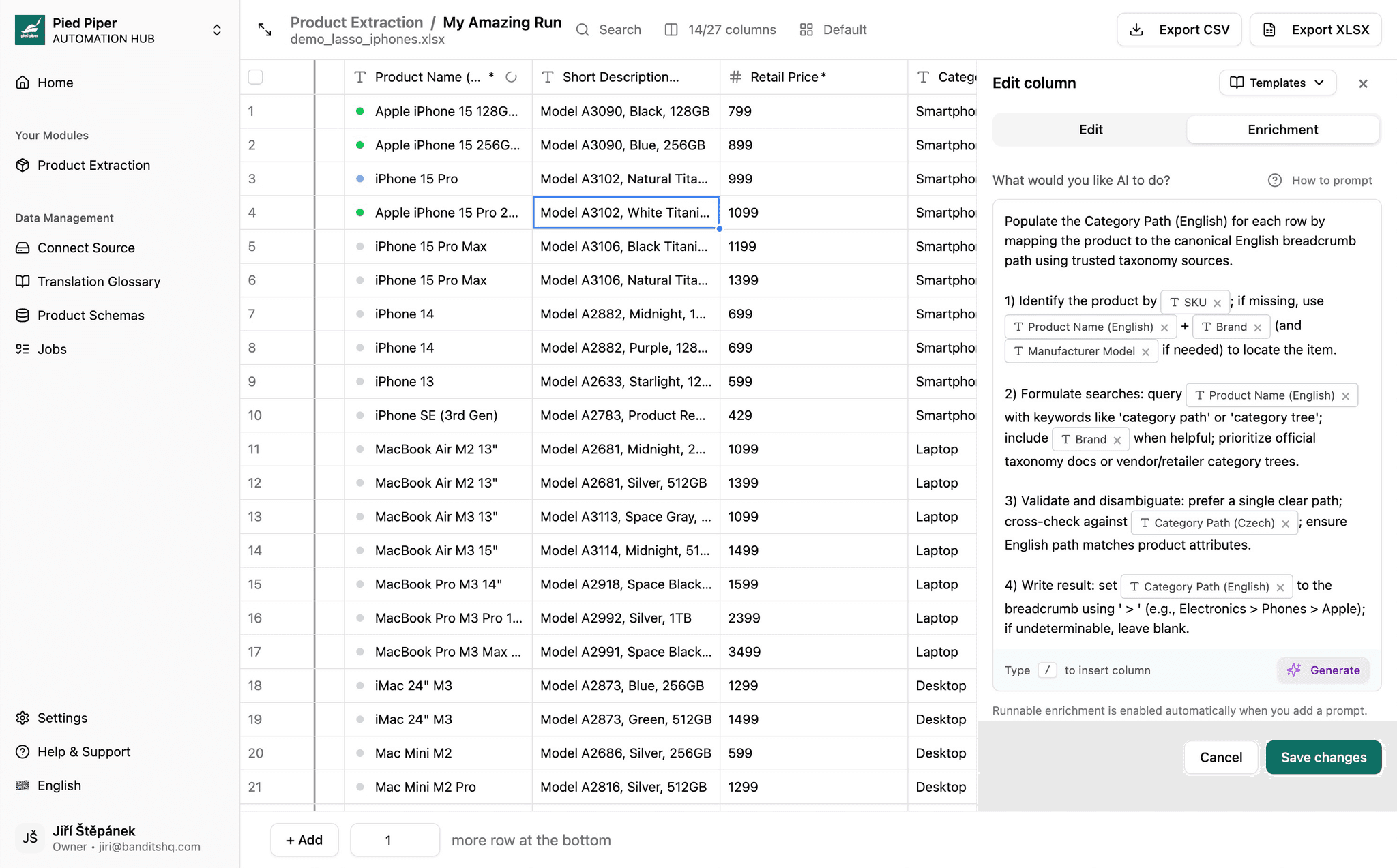
Lasso's AI-powered platform automates the entire optimization process, from attribute enrichment to channel-specific content generation, helping e-commerce teams maintain competitive feed quality without manual effort.
Mastering Title Optimization for Modern Shopping Channels
Product titles remain the single most important feed element for search matching and ad performance. In 2026, the best-performing titles balance keyword optimization with natural readability, structured specifically for each channel's algorithm.
The modern title formula prioritizes these elements:
Brand + Primary Product Type + Key Differentiators (Material, Color, Size) + Specific Model/Variant
For example: "Patagonia Better Sweater Fleece Jacket - Men's Quarter-Zip - Navy Blue - Medium" performs significantly better than generic titles like "Men's Fleece Jacket" because it provides multiple matching signals for search algorithms and immediately communicates value to shoppers.
Current best practices for title optimization:
- Front-load category and brand — these are the highest-value matching signals and appear in truncated mobile views
- Include searchable attributes — color, size, material, and gender are the most common search refinements
- Stay within character limits — Google Shopping allows 150 characters, but display truncates at 70, so prioritize accordingly
- Avoid prohibited content — promotional language, special characters, and all-caps text violate policies and trigger disapprovals
- Maintain natural readability — AI algorithms now evaluate title quality and penalize keyword stuffing
Title optimization at scale requires systematic templating. Define title patterns by product category, then apply them consistently across your catalog. For brands managing thousands of SKUs, Lasso's AI title generation can automatically create channel-optimized titles following your templates while incorporating category-specific best practices.
Feed performance data from 2026 shows that merchants who implement structured title templates see 30-40% improvements in impression share within the first month. The impact compounds over time as algorithms learn to trust your feed quality.
Creating High-Converting Product Descriptions
Product descriptions serve dual purposes in modern feeds: they provide matching signals for search algorithms and conversion-focused content for shoppers who click through to your product pages. The best descriptions optimize for both.
Structure descriptions for AI parsing and human reading:
Start with a compelling benefit statement that incorporates your primary keyword naturally. Follow with a scannable feature list using bullet points or short paragraphs. Include technical specifications that match common search queries. End with usage scenarios or problem-solving context that helps shoppers visualize the product.
Key elements of optimized descriptions in 2026:
- Semantic keyword coverage — AI algorithms understand related terms and concepts, so include synonyms and related features naturally
- Attribute consistency — descriptions should reinforce attributes defined elsewhere in your feed structure
- Length optimization — aim for 500-1000 characters for most products, providing substantial content without overwhelming algorithms
- Unique content — duplicate descriptions harm quality scores across all channels; every product needs distinct content
- Category-specific details — apparel needs fit and care information, electronics need compatibility and specs, consumables need ingredients and certifications
Many e-commerce teams struggle with description uniqueness at scale, especially for similar product variants. AI-powered content generation solves this by creating unique descriptions that maintain brand voice while incorporating product-specific details. Our guide on product descriptions that sell covers advanced techniques for maximizing conversion impact.
Feed description quality directly correlates with cost-per-click performance. Google Shopping's quality score algorithm evaluates description relevance and completeness, rewarding better content with lower CPCs and better ad positions. Merchants typically see 15-25% CPC reductions after systematic description optimization.
Structured Attributes and Modern Feed Requirements
While titles and descriptions capture attention, structured attributes drive modern feed performance. Shopping platforms increasingly rely on attribute data for faceted search, personalized recommendations, and AI-powered product matching.
Critical attributes for 2026 feed optimization:
- Product identifiers — GTIN, MPN, or brand-specific SKU (now required by most channels for branded products)
- Product type hierarchy — use platform-specific taxonomies like Google Product Category or Amazon Browse Nodes
- Color and size — standardized values that match channel enumerations for proper filtering
- Material and construction — fabric composition, primary materials, manufacturing methods
- Target audience — age group, gender, life stage for improved personalization
- Custom labels — platform-specific fields for bidding segmentation and campaign optimization
Attribute completeness has become a competitive necessity. Google Shopping now requires at least 3-5 core attributes beyond title and description for most categories to maintain good standing. Meta Advantage+ campaigns prioritize products with 8+ defined attributes when making automatic product selections.
Strategies for comprehensive attribute enrichment:
Map your internal catalog structure to channel-specific attribute taxonomies. Identify gaps where required or recommended attributes are missing. Implement attribute inference rules where explicit data doesn't exist — for example, extracting color from titles or images when color fields are empty.
Manual attribute enrichment becomes impractical above a few hundred SKUs. Lasso's attribute enrichment uses AI to automatically extract and populate missing attributes from product titles, descriptions, images, and specification sheets, typically achieving 95%+ attribute completeness within hours.
The ROI of attribute optimization is clear: products with complete attribute sets receive 50-70% more impressions in category-specific and filtered searches compared to products with sparse attributes. This visibility advantage translates directly to increased traffic and revenue.
Image Quality Standards and Visual Optimization
Product images are the first element shoppers evaluate when scanning search results and feeds. Image quality directly impacts click-through rates, with high-quality images generating 2-3x more clicks than low-quality alternatives.
2026 image requirements across major channels:
- Resolution — minimum 1000x1000 pixels, with 2000x2000 recommended for zoom functionality
- Aspect ratio — square (1:1) remains the safest choice across all channels, though some platforms now support 4:5 for apparel
- Background — pure white (#FFFFFF) or transparent for main images; lifestyle settings acceptable for additional images
- Product coverage — product should fill 80-90% of frame without appearing cropped
- Variant representation — each color/style variant requires accurate images showing actual product appearance
- Image count — 4-8 images per product (main image plus additional angles, details, and lifestyle shots)
Common image violations to avoid:
Products not filling the frame, visible watermarks or logos, promotional text overlays, collages showing multiple products, low resolution or pixelation, images showing wrong product variants. These violations trigger automatic disapprovals and require resubmission with corrected images.
Shopping platforms now use computer vision to evaluate image quality automatically. Google's image quality score considers resolution, composition, background cleanliness, and product visibility. Products with high image quality scores receive preferential placement in visual search and discovery features.
Beyond technical requirements, image optimization includes strategic presentation. Products with lifestyle images showing usage context convert 25-40% better than products with only white-background shots. Include detail shots of key features, size comparison references, and multiple angles to reduce purchase uncertainty.
For e-commerce teams managing large catalogs, maintaining image quality standards requires systematic processes. Establish image guidelines, implement pre-upload validation, and monitor for quality issues across your feed. The guide to bulk product listing on Shopify includes comprehensive image workflow recommendations.
Feed Health Monitoring and Continuous Optimization
Feed optimization is not a one-time project but an ongoing process of monitoring, testing, and refinement. Shopping channels regularly update requirements, competitors adjust their strategies, and your own catalog constantly evolves with new products and updates.
Essential feed health metrics to track:
- Error rate — percentage of products with disapprovals or warnings across each channel
- Attribute completeness — average number of populated attributes per product and category
- Impression share — the portion of potential impressions your products actually receive
- Click-through rate by product — identifies underperforming products needing optimization
- Conversion rate by feed element — connects specific optimizations to revenue impact
Most e-commerce platforms provide basic feed diagnostics, but they focus on technical errors rather than optimization opportunities. Comprehensive feed analytics should connect feed quality metrics to business outcomes, showing which optimizations drive the most revenue.
Systematic optimization workflows:
Establish a monthly feed audit process to identify new optimization opportunities. Review products with high impressions but low CTR — these need better titles or images. Analyze products with low impression share despite good inventory — these may need better category mapping or attribute enrichment. Test title variations for top-selling products to find performance improvements.
A/B testing at the feed level requires careful methodology since most channels don't support split testing. The best approach is sequential testing: implement changes to a product subset, measure performance over 2-4 weeks, then roll out winning variations to the full catalog. Document results to build an optimization playbook specific to your catalog and channels.
Lasso's feed analytics connects feed quality metrics directly to channel performance data, automatically identifying optimization opportunities and quantifying their potential impact. This makes it easy to prioritize optimization efforts based on ROI rather than guesswork.
Feed optimization maturity correlates directly with e-commerce success. Merchants who implement systematic optimization processes see year-over-year feed-driven revenue growth of 30-50%, while those treating feeds as a set-it-and-forget-it technical requirement see stagnant or declining performance as competitors pull ahead.
Getting Started with Systematic Feed Optimization
Optimizing your product feeds for maximum visibility requires strategy, consistency, and the right tools. Whether you're managing 100 products or 100,000, the principles remain the same: complete accurate data, channel-specific optimization, and continuous improvement.
Your feed optimization roadmap:
Start with a comprehensive feed audit to establish your baseline. Identify quick wins like missing GTINs or incorrect category mappings that can be fixed immediately. Prioritize title and description optimization for your top-selling products where improvements have the greatest revenue impact. Implement attribute enrichment systematically by category. Establish monitoring and testing processes for ongoing optimization.
For teams managing feeds manually or using basic automation, the operational burden quickly becomes overwhelming. Spreadsheet-based workflows don't scale beyond a few hundred products, and manual content creation becomes a bottleneck for catalog growth. This is where AI-powered feed management platforms deliver transformative value.
The guide to product data enrichment in 2026 provides additional context on modern approaches to catalog optimization, including how leading e-commerce teams structure their data workflows for scale.
Ready to transform your feed performance? Lasso's AI-powered platform automates every aspect of feed optimization — from attribute enrichment and content generation to channel-specific formatting and ongoing monitoring. See exactly where your optimization opportunities are and how much revenue you're leaving on the table with inadequate feed quality.
Book a demo and we'll show you how optimized feeds can transform your e-commerce performance across every sales channel.